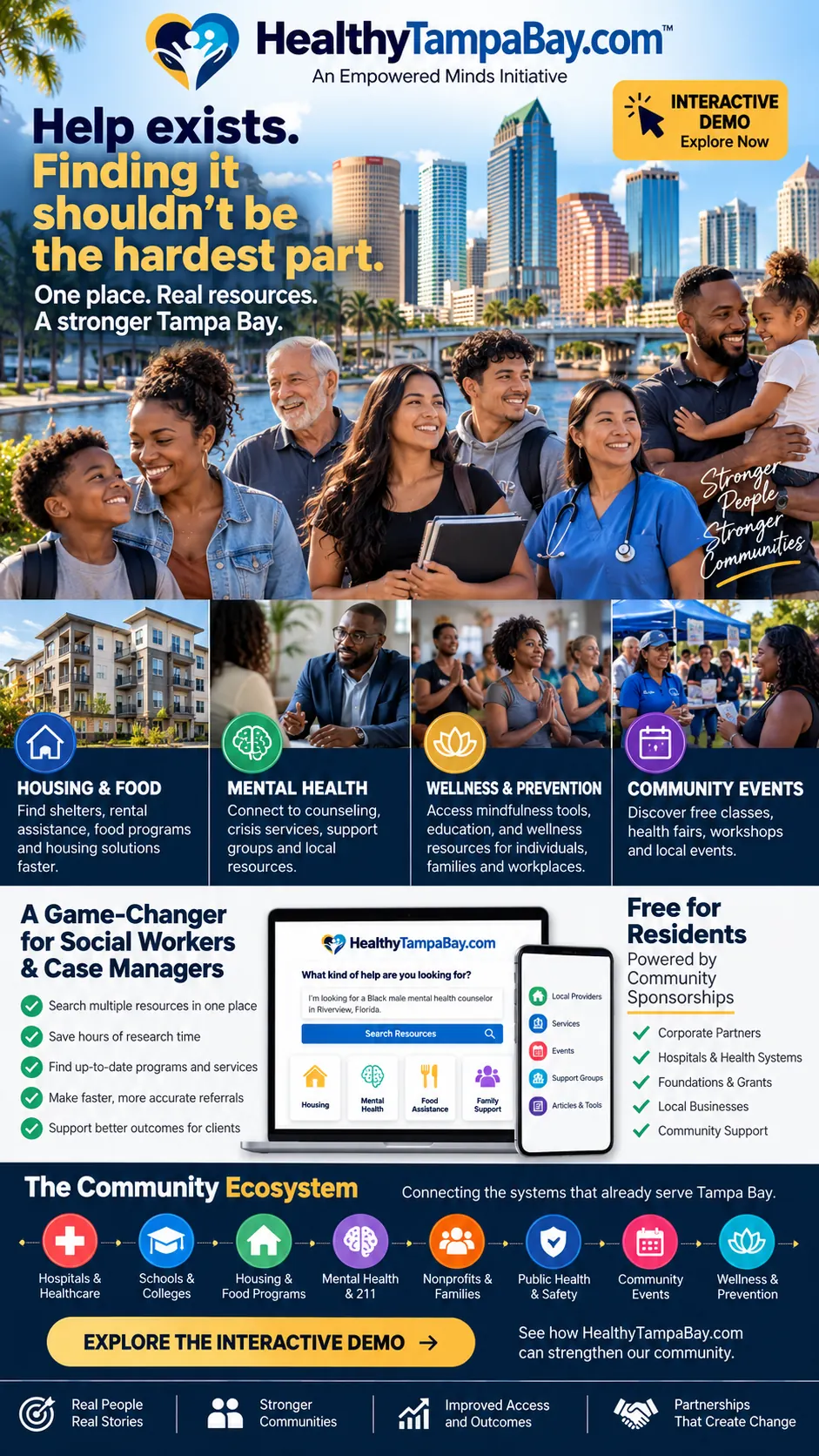
When life changes, access to care shouldn't disappear.
Job loss. A lapse in coverage. A missed psychiatric prescription. A hurricane. Housing insecurity. Family crisis. People rarely experience these challenges one at a time—and existing help can be difficult to find, understand or reach.
Respondents who reported not receiving needed mental health care in the preceding year. Study
Respondents who were unsure whether their insurance covered mental health care. Study
Reported delaying, skipping or not receiving needed care or medication because of cost. KFF evidence
The study populations differ. These figures support the access problem; none measures impact delivered by Healthy Tampa Bay.
Our proposition
A trusted, accessible entry point to existing help, combined with community education, targeted public awareness, partnership coordination and an accountable way to measure whether people connect to services.
More than a directory. A coordinated community response.
Find and connect
Search trusted mental health, primary care, recovery, housing, food, transportation and family resources by location, eligibility, demographic and affordability.
Prevent and educate
Coordinate 988 visibility, Mental Health First Aid, school and workplace wellness, peer support, suicide prevention and culturally responsive public outreach.
Support recovery
Build pathways with existing organizations for behavioral health, substance use, naloxone awareness, veterans, children, college students and caregivers.
Bridge life's disruptions
Help residents navigate employment and insurance loss, prescription access, coverage transitions and referrals to affordable clinics.
Prepare for disasters
Offer preloaded preparation guidance, official alert links, shelters, prescription continuity information and recovery resource updates.
Measure connection
Track verified resources, search-to-contact activity and optional consent-based referral follow-up—without exposing personal health data to advertisers.
Built for ordinary days—and extraordinary ones.
Before
Emergency planning, medication records, preparedness education, local alert sign-up and downloadable resource information.
During
Official evacuation and shelter links, essential service notices, verified community updates and crisis-support guidance.
After
Food, housing, replacement prescriptions, benefits access, counseling, disaster assistance and long-term recovery connections.
Infrastructure reality: A downloaded app can store reference information offline, but it cannot guarantee fresh alerts when all communications networks are down. Official emergency broadcasts, NOAA Weather Radio, local emergency management and other backup channels remain essential.
Florida emergency prescription-refill rules apply only under specified conditions and do not override all controlled-substance prescribing restrictions. Florida statute 252.358
A starting point, not the complete solution.
The public-facing resource hub demonstrates how residents may find help by county, city, age group, gender preference, student or veteran status, insurance, specialty and virtual care. It is only one component of the larger framework.
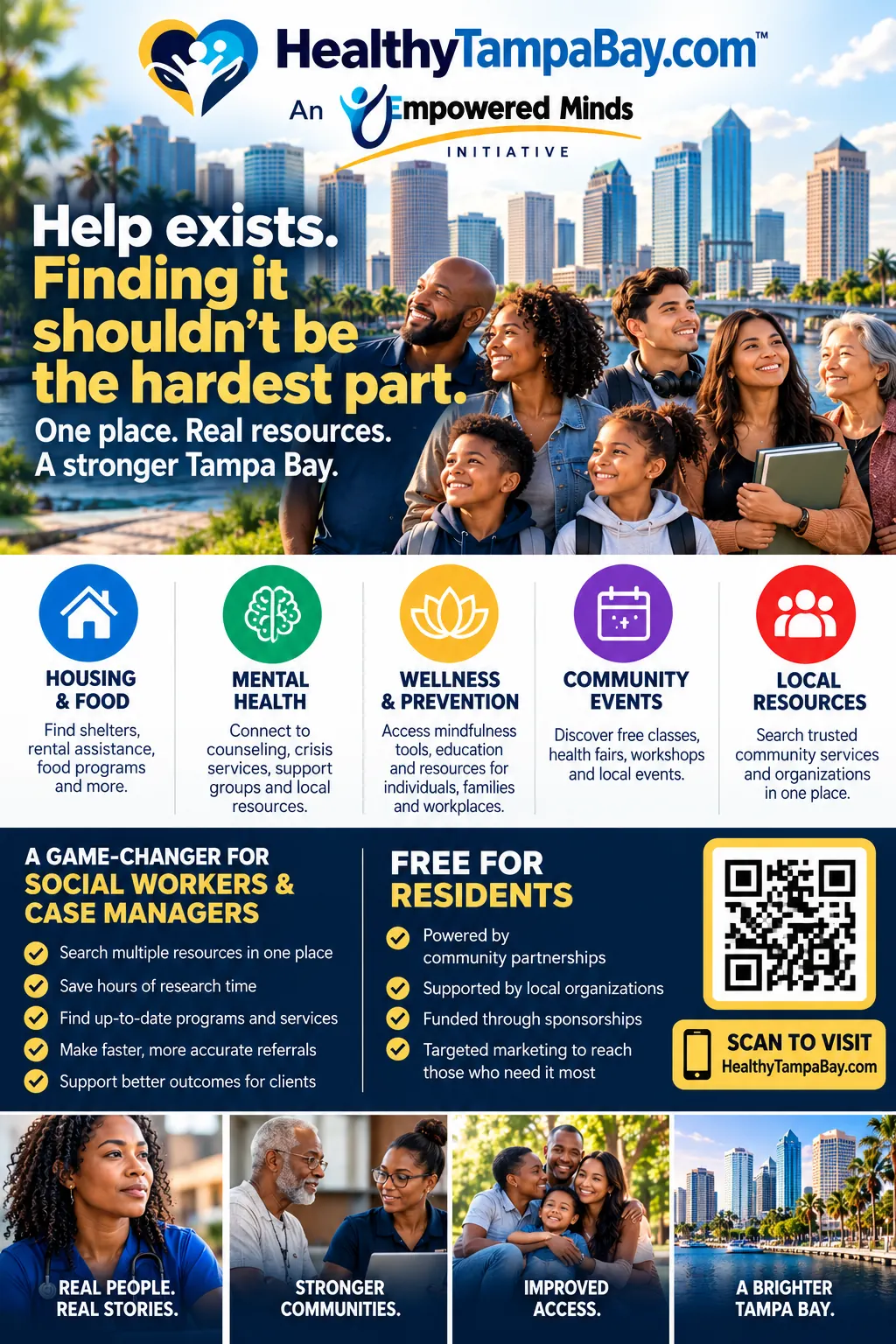
Designed for Tampa Bay. Adaptable to other communities.
The approach brings together suicide prevention, health literacy, outreach campaigns, recovery partners, civic and employer engagement, neighborhood resource visibility, referral navigation and measurable follow-through.
It draws on community experience in Mental Health First Aid, mindfulness education, NAMI leadership, Hillsborough suicide-prevention coalitions, and professional speaking engagements including Kansas City Chamber of Commerce programming. This is experience informing the proposal, not an assertion that those organizations have approved or adopted this specific initiative.
Potential adaptation markets: New York, Atlanta, Chicago, San Francisco Bay Area, Los Angeles, Las Vegas and Houston. Any implementation would require locally validated needs, new partners and jurisdiction-specific governance.
Build evidence before making outcome claims.
The original feasibility prospectus proposed an initial Hillsborough-first pilot and a 12-month outreach effort. The targets below are aspirational and contingent on funding, governance and delivery capacity.
Validation, provider records, outreach assets, pilot activity and measurement planning. Not a final priced implementation budget.
Measurable accuracy, eligibility and direct contact information through a defined review cycle.
Recruit and verify partnerships; no relationship claimed until confirmed.
What we would measure
- 1Directory coverage, accuracy and last-reviewed dates
- 2Community campaign reach and engagement
- 3Anonymous or consent-based referral attempts and confirmed connections
- 4Training participation, knowledge change and follow-up
- 5County, population and service gaps to prioritize next
What would be required
- 1Lead organization, governance and fiscal sponsorship/eligibility review
- 2Verified data operations and human moderation
- 3Secure hosting, accessibility, privacy and disaster readiness
- 4Paid and earned-media awareness campaigns
- 5Community and provider partnerships plus independent evaluation
What could your community do if help were easier to find?
Healthy Tampa Bay is seeking conversations with hospital systems, funders, insurers, educators, public health, veterans’ groups, nonprofit organizations, employers and community recovery partners.
The early framework envisions sponsorships, philanthropic support, program partnerships, resource underwriting, community events and an accessible free baseline directory. Paid promotion would be clearly labeled and cannot override clinical relevance or resource eligibility.
The contact email above is a proposed public contact route and must be verified before production publication. This page is a project concept and demonstration, not a claim of clinical service delivery or existing grants.
Evidence and project references
- Tampa Bay Thrives, 2024 Resident Mental Health Study
- KFF, Key Facts About the Uninsured Population (2024 NHIS data)
- Florida Statutes, emergency preparedness prescription medication refills
- Florida Division of Emergency Management, medication preparedness
- Healthy Tampa Bay feasibility and initiative working prospectus, October 2026, internal planning document (targets and assumptions, not published outcomes)